

‘Dubai is back’.
As September begins, a three-word post with a photo of gridlock traffic in Dubai perhaps best captures the general current mood of Gulf determination and resolve. It’s also a useful barometer of economic activity: after the Iran war began on February 28, Dubai’s heavy traffic had eased as tourists stayed away and work-from-home measures proliferated.


Big events returning
There are other tangible signs that some kind of normality is returning to the Gulf. A new Fortune magazine interview by Inzamam Rashid with Dubai Airports CEO Paul Griffiths shows that Emirates and Flydubai carriers are now back to 90 per cent of their usual levels, and even overall traffic is now back to 80 per cent.
This is being helped by foreign airlines slowly coming back to the region - Air France resumed flying to Dubai on August 26, while British Airways operated its first flight to Doha yesterday.
Major conferences and events are also restarting in the Gulf. This week’s massive LEAP technology conference in Riyadh, originally scheduled for April, is the biggest event yet that was delayed by the war to be successfully held, featuring more than 1,000 speakers and 1,800 technology brands - and some $15 billion in dealmaking on the sidelines, including for new data centres. And in the UAE, upcoming major events this month include the Arab Media Summit in Dubai and the Abu Dhabi International Book Fair.
Reality check
The overall spirit of optimism comes despite this week’s very real flare-up of tensions between the US and Iran, which included confirmed Iranian strikes against Bahrain and Kuwait and the Saudi-owned oil tanker Sidr, which was attempting to transit the Strait of Hormuz.


The attack on the Sidr, owned by Saudi national shipping company Bahri, caused the deaths of two Filipino sailors. And there was also another tanker hit on Monday night, on the South Korean supertanker Senegal Prosperity. Each of the ships were carrying some two million barrels of Saudi crude oil.
The exact targets in Bahrain and Kuwait are unclear, but it’s significant that they have been officially confirmed. A statement from Bahrain’s foreign ministry condemned ‘renewed Iranian attacks involving missiles and drones’, without giving further details.
A Kuwaiti foreign ministry statement was slightly more forthcoming, expressing ‘condemnation and strong denunciation of the Iranian criminal attacks using missiles and hostile drones that targeted several sites in the country at dawn today, including a residential complex’.
Iran’s Islamic Revolutionary Guard Corps (IRGC) claimed that it had struck the Sheikh Isa Airbase that houses US troops in Bahrain, along with the headquarters and residence of the US commander at the Ali Al Salem airbase in Kuwait. However, there is no independent confirmation of either of these targets, or the extent of any damage.
Gulf solidarity
Other Gulf states have issued statements in solidarity with both Bahrain and Kuwait (along with Jordan, which was also targeted) and with Saudi Arabia for the tanker incident.
For example, Qatar’s foreign ministry said the country ‘strongly condemns’ the attacks, which it considered ‘a flagrant violation of the sovereignty and territorial integrity of the targeted countries, and a blatant breach of international law, the United Nations Charter, and the principles of good neighbourliness’.
Meanwhile, the UAE said the attack on the Sidr was ‘a grave threat to the safety and security of international navigation and represents a dangerous escalation aimed at undermining the security and stability of one of the most critical waterways in the world.’
More on the Mecca Defence Alliance
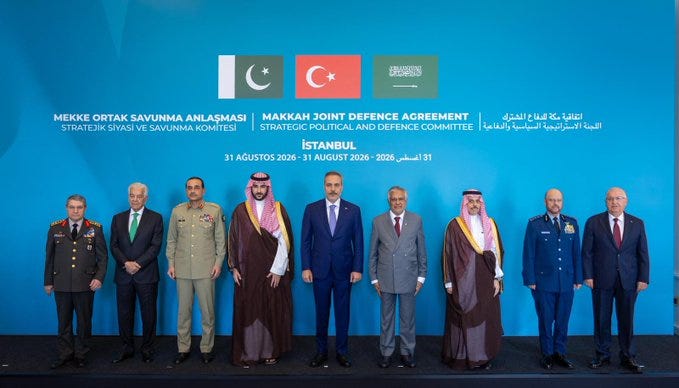
This week has also brought more details of the Mecca Joint Defence Agreement, announced in early August, now also officially called the Mecca Defence Alliance. It binds Pakistan, Saudi Arabia and Türkiye. A meeting of the alliance’s Political and Strategic Defence Committee was held in Istanbul on Monday.
Mecca Agreement: the new Saudi Arabia, Pakistan & Türkiye defence pact that could shake up the Middle East

A much-anticipated defence pact between Saudi Arabia, Pakistan and Türkiye is here - with major ramifications for the wider Middle East.
A joint statement issued after the meeting is available via the Saudi Press Agency. The key takeaway? A permanent secretariat is being established in Saudi Arabia, which will be led by a Pakistani Secretary-General for an initial three-year term.
Interestingly, while the original statement at the launch in August emphasised ‘any armed attack against any one of the three states shall be regarded as an attack against them all’, the phrasing wasn’t repeated this time.
Of course, this does not mean it’s being dropped - there’s a reference to the ‘credibility and effectiveness of collective deterrence and defence’ - but it might be a sign that the three partners don’t want this messaging to become the sole focus of the new arrangement.
Peaceful resolution of crises
Indeed, this week’s statement noted the need to ‘support efforts aimed at de-escalation and restraint, thereby encouraging the peaceful resolution of crises’. And Pakistan, Saudi Arabia and Türkiye are also seeking to ‘enhance their defence capabilities and the cohesion of their armed forces through strong cooperation in the defence industries sector and the development of joint production and technologies’.


For the Saudi perspective, a must-read on the Mecca Agreement is an opinion piece published by the highly influential former Saudi intelligence chief Prince Turki Al-Faisal, who signals the alliance could expand (Egypt and Bangladesh are among the likely candidates) and grounds the alliance firmly in Riyadh’s desire to diversify its security and foreign policy arrangements beyond Washington:
While the Kingdom has maintained a strategic relationship with the US, both historically and in contemporary times, it has also developed multifaceted strategic partnerships with China, Russia, the EU, and most countries worldwide, except the Zionist entity. These relationships are founded on shared interests and mutual benefits, and are intended to advance the Kingdom’s security, stability and broader strategic space.
The significance here is that Prince Turki’s views can be taken as an informal reflection of Saudi foreign policy - and it’s clear that this is just the beginning for the Mecca Defence Alliance.
What commentators are saying
For a good discussion of all the issues, it’s worth watching the 28-minute discussion programme Inside Story from Al Jazeera English, which was recorded after the meeting in Istanbul on Monday.
Guests included Rabia Akhtar, Dean of Social Sciences at the University of Lahore; Galip Dalay, a senior research fellow at Chatham House; and Muhanad Seloom, a non-resident senior fellow at the Middle East Council on Global Affairs, who told the programme that the NATO membership of Türkiye and Saudi Arabia’s own role in the Gulf Cooperation Council (GCC) raise questions for the alliance:
'Today in the press conference, Hakan Fidan, the foreign minister, said that this integrates with the existing commitments of Türkiye towards the NATO and vice versa. What does that mean? I think it needs to be explained.
On the other side, you have also Saudi Arabia, which is member of the GCC. It has also its own defence component. What does that mean also for Saudi Arabia and its commitments to the GCC? I think it's yet to be explained. Would other GCC countries join this alliance?
Meanwhile, on X, Zarqa Parvez, a non-resident fellow at the Gulf International Forum, wrote: ‘This is not a defence agreement with add-ons. It is the foundation of a new regional security architecture, one built on the needs and realities of the region itself, not dictated from outside it. We are watching the beginning of a new era. Not a treaty. A framework for a new balance of power and security strategy in the region, and the region is writing it on its own terms.’
And academic Ali Bakir also has a fascinating article looking at why Egypt is not part of the pact already, despite its links with the three founding members - could it be to do with potential contradictions with Egypt’s existing peace treaty with Israel?
Bottom line
Six months after the Iran war began, the Gulf is moving on - or at least trying to.
The early months of the war were a reactive period, shaped by US, Israeli and Iranian actions.
There’s now a sense of a more proactive approach and taking security matters into the Gulf’s own hands.
The Mecca Defence Alliance is a reflection of this new strategy - as is the determination to get back to business and push ahead with major economic projects.
The impact of the war hasn’t gone away, but the Gulf isn’t waiting around for a permanent resolution either.